
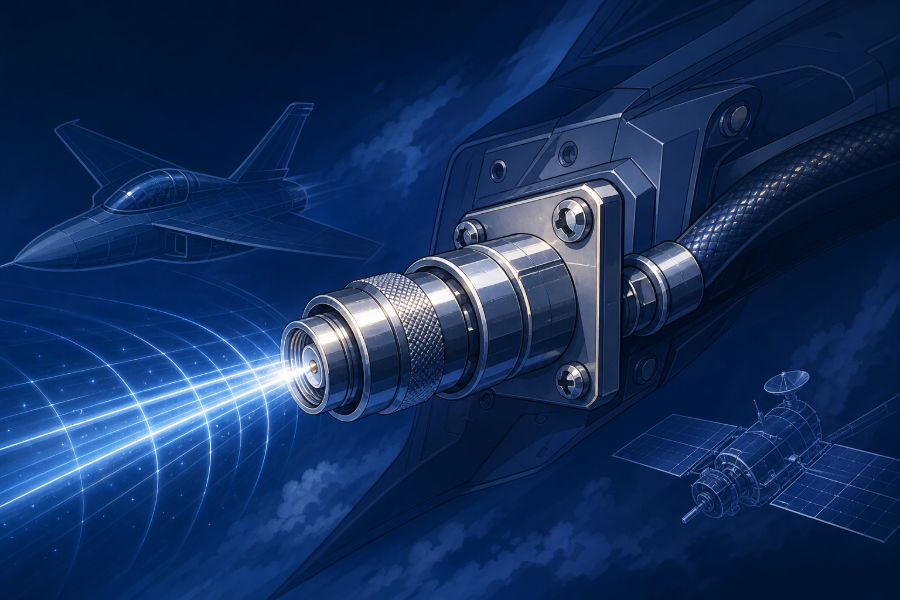
Reliable RF Performance in Extreme Conditions
Amphenol Military & Aerospace (AMAO) develops RF and microwave interconnect architectures engineered to perform across demanding defense and aerospace environments. In radar, secure communications, and electronic warfare systems, these interconnects maintain signal integrity under severe vibration, shock, and thermal cycling. Even minor impedance discontinuities can influence return loss and data fidelity, so AMAO applies controlled impedance geometries and repeatable termination methods throughout connector and cable manufacturing.
System-Level Design Integration
At microwave frequencies, every connector and transmission path acts as an integral component of the system’s electromagnetic behavior. AMAO engineers model field distributions and mechanical tolerances concurrently, ensuring impedance uniformity and phase stability across mated pairs. This design philosophy enables low reflection coefficients, stable insertion loss, and consistent shielding effectiveness through the connector–cable–chassis interface. Integration at the subsystem level allows coordinated performance across assemblies linking receivers, transmitters, and phased-array modules.
Materials and Environmental Resilience
Material selection governs long-term RF stability. Low-loss fluoropolymer dielectrics, precision-machined conductors, and corrosion-resistant platings preserve electrical and mechanical integrity throughout operational life. For pressurized or moisture-prone environments, hermetic configurations using glass-to-metal seals prevent leakage and outgassing. Strain-relief components and vibration-damping backshells mitigate micro-movement that can shift contact impedance. Cables may use semi‑rigid, conformable, or braided shield designs tuned for specific routing and electromagnetic containment requirements.
Cross‑Disciplinary Engineering within AMAO
AMAO brings together specialized RF expertise from across its businesses: Narda‑MITEQ for microwave modules, Micro‑Coax and Times Microwave for low‑loss coaxial assemblies, and SV Microwave for precision connector interfaces. Amphenol Aerospace and Amphenol Military High Speed translate these component‑level designs into aircraft and platform harness applications, while Amphenol Printed Circuits provides RF launch and backplane interface technology. Unified processes and shared qualification standards ensure consistent electrical performance from connector contact to integrated module.
Testing, Qualification, and Standards Compliance
All AMAO RF and microwave interconnect products undergo comprehensive testing for vibration endurance, thermal shock, humidity, and salt fog in accordance with applicable MIL‑DTL and aerospace standards. Electrical verification includes insertion loss, voltage standing wave ratio (VSWR), shielding effectiveness, and phase tracking assessments. Quality management follows defense and aerospace frameworks to maintain traceability and process control across global production. These measures ensure connectors and assemblies meet stringent mission‑specific reliability benchmarks.
Application Context and System Reliability
Reliable interconnect performance is critical in airborne radar arrays, satellite transponders, and tactical ground systems where signal degradation directly affects mission outcomes. AMAO products address mechanical durability and electromagnetic compatibility requirements for complex RF architectures. Through its portfolio—spanning RF Adapters, Terminations & Loads, precision Attenuators, and integrated harnesses—AMAO provides design paths that maintain impedance control and minimize passive intermodulation across the complete signal chain.
Conclusion
AMAO’s approach to RF and microwave interconnect engineering combines electromagnetic precision, robust materials, and proven qualification processes. The result is a unified interconnect ecosystem supporting high‑frequency reliability in the world’s most demanding aerospace and defense platforms. Engineers can explore supporting documentation through Advanced Materials & Processes resources or initiate design collaboration via the Request a Quote page.