
High-Speed Connectivity for Mission-Critical Platforms
Modern mission systems process multi-gigabit data streams in real time. Interconnect reliability directly influences timing precision, electromagnetic compatibility, and computational throughput. Amphenol Military & Aerospace (AMAO) designs high-speed connector systems capable of maintaining consistent transmission characteristics under vibration, temperature cycling, and electromagnetic stress. These designs support backplane and module interconnections across airborne, land, and maritime computing environments.
Controlled Impedance and Signal Integrity
Each high-speed contact pair is engineered for stable differential impedance. AMAO employs simulation-led optimization of conductor geometry, dielectric spacing, and ground-return path placement to achieve predictable crosstalk and insertion loss behavior across a wide frequency spectrum. Low-dispersion dielectric materials and high-cycle copper-alloy contacts maintain consistent impedance under thermal and mechanical loading. The result is reduced jitter accumulation and preserved eye pattern performance at multi-gigabit signaling rates.
Mechanical Alignment and Modular Integration
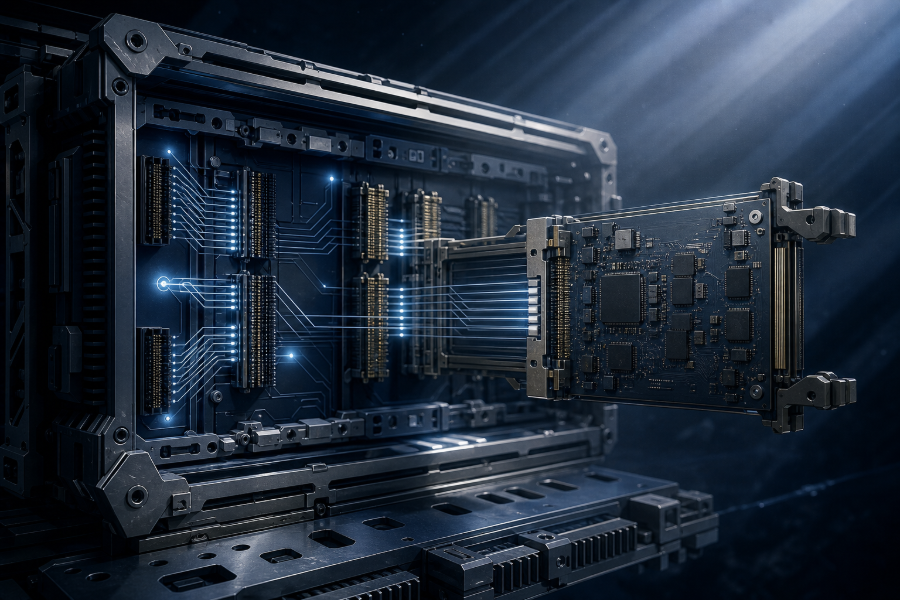
Electrical performance is reinforced by mechanical precision. Alignment keys, grounding shells, and retention hardware control module deflection and ensure repeatable mating geometry. Controlled stack-up tolerances throughout the backplane and daughtercard interface minimize deformation-induced impedance variation. The modular approach used within AMAO connector systems allows system architects to implement high-speed payload and I/O configurations while retaining mechanical interchangeability and backward-compatible interfaces.
Complementary AMAO backplane assemblies employ defined impedance routing and common grounding topologies that extend connector performance across the full backplane channel. Integrated thermal conduction plates and high-conductivity fasteners manage localized heating from transceiver components and maintain contact resistance stability.
Environmental Qualification and EMC Assurance
AMAO interconnects are subjected to qualification regimes addressing vibration, thermal shock, humidity, salt fog, and contaminant exposure consistent with MIL-STD environmental categories. Electrical continuity, contact resistance, and shielding effectiveness are verified after mechanical and climatic stress to confirm repeatable performance. 360-degree EMI backshell configurations and precision cable termination accessories ensure complete return-path continuity and minimized radiated emissions. These measures preserve both compliance and system-level electromagnetic integrity.
Collaborative Design Across AMAO Divisions
Amphenol Military High Speed develops advanced contact and insert geometries optimized for controlled impedance performance. Amphenol Aerospace complements these designs with rugged shell systems and high-density modular packaging. Amphenol Printed Circuits contributes board-level interconnect solutions, ensuring electrical continuity from transceiver to interface. Unified engineering and test methodologies across these groups enable full-path validation and reduce interface uncertainty during integration.
Application Context and Engineering Direction
High-speed interconnects from AMAO are deployed within mission processors, data concentrators, and avionics control units requiring deterministic latency and low bit error rates. Evolving open-architecture platforms continue to demand higher signaling bandwidths and reduced noise susceptibility. Future AMAO development focuses on optimized material systems, advanced plating chemistries, and refined signal reference structures to support upcoming protocol generations while maintaining MIL-qualified ruggedness.
Conclusion
High-speed interconnect engineering depends on balanced electromechanical design—maintaining impedance accuracy, environmental durability, and configurational flexibility. Amphenol Military & Aerospace applies these principles across its connector, backplane, and assembly portfolio to deliver consistent data integrity and enduring reliability in next-generation defense and aerospace computing systems.